Showing posts with label Female Fashion Designer. Show all posts

Wednesday, June 22, 2016

From Freedom Tower to Fifth Avenue, Puey Quinones Takes On New York

Filipino designer Puey Quinones walks down the runway with his muse Jessica Ming Anh during the show. (Photo courtesy of Puey Quinones)
Just 10 months in since he moved to the United States, Filipino designer Puey Quinones is already making waves in the American fashion industry.  The now Los Angeles-based designer flew to New York upon invitation of renowned supermodel and fashion producer Jessica Minh Anh for an exclusive fashion show at the iconic Freedom Tower of the World Trade Center in New York last June 25. Quinones opened the said show and premiered his haute couture collection for 2014.  Nine designers were featured in the show, all chosen for their civic engagements and socially-conscious creations.  Puey’s initiative, Project Bilibid Runway, which he started in 2007, helps the inmates in the Maximum Security ward of the New Bilibid Prison in Muntinlupa City, Philippines by teaching them fashion skills.  The goal is to train them towards creation of clothes – from draping, pattern making, sewing, hand-painting fabrics, and the like – to help them transition into the society and give them livelihood. He provides the materials and tries to use as much local textiles and weaves as he can such as jusi, pina, and silk cocoon in the designs.Days prior to the show, Puey paid a courtesy call on Consul General Mario De Leon at the Philippine Consulate in New York to collaborate on projects to promote the designer in New York.  Some of his designs featured during the fashion show will be displayed at the show windows of the Philippine Center on Fifth Avenue from July to August.
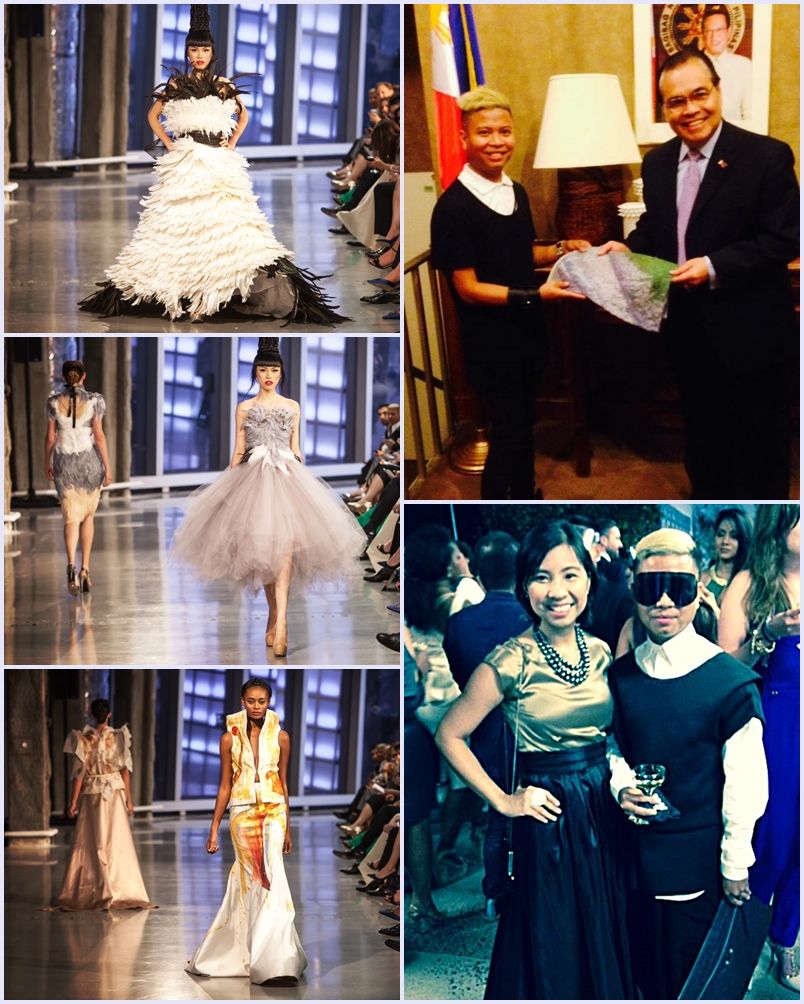
Clockwise from top right: Puey pays courtesy call on Consul General De Leon and gifts a hand-painted jusi wrap, a product of his Project Bilibid Runway; Vice Consul Khrystina Corpuz poses with the designer before the fashion show; Hand-painted modern Filipiniana and feathers were the motif of Puey’s collection which will be displayed at the Philippine Center show windows. (Photos from Puey Quinones)

Puey Quiñones– from runway to redemption

FOR FOUR years now, Quiñones has been spending Tuesdays teaching inmates about fashion, dressmaking and tailoring.
It was a scandal of epic proportions.
In February last year, fashion designer Puey Quiñones was caught trying to pass off a department store-bought jacket as his own creation. Shea Gamboa, the furious bride-to-be whose groom Jhon Maala commissioned the suit for their wedding, tweeted about what people soon referred to as “a fashion scam.”
Within hours, the tale of retagging had become a full-blown controversy that brought the designer to his knees.
Rewind
Growing up in Samar, Quiñones did not dream of becoming a fashion designer.
“I didn’t even know what fashion was. I grew up in a small town. I was older than 10 when we got our first TV.”
He had visions of being on the center stage but he wasn’t sure how.
“I tried singing, I joined contests. But puberty hit and my voice changed. So I tried dance. Then I said, this is it. I’ll become a teacher, I’ll teach dance.”
But his father, a policeman, had other plans for him.
“He asked me to take up Political Science. I think he was hoping na magiging straight pa ako.”
After three years of Political Science at University of Eastern Philippines, Quiñones wasn’t happy at all. He heard that his aunt, who was based in Manila, was going into partnership with fashion designer Dennis Lustico.
“I asked her, can I just work for you? You don’t have to pay me. Gusto ko lang lumayo.”
He made the big move to Manila and started earning money by volunteering to wash his aunt’s car. Soon, he started working for Lustico.
“I was his assistant. I was very happy doing that—working on the finishing touches, sewing the buttons, answering the phones.”
Although he was starting to feel the urge to create his own designs, at first, Quiñones resisted. “I always thought fashion was only for rich kids.” But then he started to sketch. “I sketched every day tapos nilalagay ko sa table ni  Dennis  para makita niya.”
When Bergamo CEO Mel Meer was looking for a designer, Lustico told Quiñones that he was ready.
“I submitted my sketches and Mr. Meer loved it. I was so happy but nervous,” Quiñones recalls.
PUEY Quiñones headlines the documentary “TheWorld’s Most Fashionable Prison.”
It was 2000 and he was only 20.
Fame
Quiñones was just starting. He joined competitions and won over clients and fashion editors with his bold, dramatic and unorthodox designs. His clientele, who included celebrities, grew exponentially. Ironically, it was the fame that he worked hard for that led to his downfall.
“I went overboard. I felt untouchable. Hindi ako babagsak. I was having a great time, I had a fabulous life. Lahat kaya ko. Nasusunod lahat ng gusto ko. Anywhere I wanted to go, I could go. Anything I wanted to eat, I could eat. I felt the power. I abused it. I came from nothing, then I had so much. I was living beyond my means. I didn’t know how to control it anymore.”
Perhaps with that power came the feeling that he could get away with anything. Then, the scandal.
Damages
At the height of the controversy, Quiñones issued a public apology. He paid Shea and Jhon almost P200,000 in refunds and damages.
But his troubles were only beginning. “I lost a lot of clients. I lost a lot of money. I lost projects. Brides canceled their orders and asked for refunds. I said I’ll try to refund as long as I can. I did it and I was willing to face the consequences.”
QUIÑONES: “I have a favorite quote from ‘Eat Pray Love.’ ‘Ruin is a gift. Ruin is the road to transformation.’ This is me. Kinailangan kong masira para umayos ulit ako.”
Quiñones’ mother, a teacher, came to his aid. “She was the one who produced money to refund my clients. She took out loans. I realized, wala talagang tutulong sa ’yo kundi family mo.”
It was his family and his closest friends who kept him afloat. “Yung mga real friends talaga, mabibilang ko lang sa aking kamay. My family and si Dennis Lustico, whom I call “mother,” never siyang tumalikod sa akin; si Ronald Magalang whom I call “father”; si Ivarluski Aseron, Pia Campos, Carmina Sanchez.”
Quiñones says practically everything he’s earned has been used to pay off debts. “The whole year, I had no income. But I’m dealing with it. I’m not running.”
The scandal took a toll on him. “I got depressed. I couldn’t design. For months, I couldn’t go out of my room. I couldn’t eat. I was just crying and praying every day. I couldn’t afford to see people. I couldn’t go to the mall. I kept thinking, what about my fabulous friends? My fabulous lifestyle? What about the parties? Hindi na ako mai-invite sa social gatherings.”
But after weeks of reflection, Quiñones’ priorities changed.
“Before this happened, I was not a religious person. I was very modern. Pero sobrang nag-iba yung mundo ko. One day, I went to church and said, ‘Okay, Lord, pagod na ako.’ I was tired of dealing with the controversy, the criticisms, the people bashing me. I deserved it, I accepted it. I didn’t blame anybody. But I was ready to face a new life. I wanted to surrender.”
That moment, which came six months after the scandal, was pivotal.
“Doon ako nagkaroon ng strength ulit. I said to God, I am willing to lose everything, just give me back my peace. I was ready to give up fashion. I was ready to go home or go to another country and start a new life. When I surrendered, gumaan yung pakiramdam ko. I said, Lord, Ikaw na bahala sa akin. Just give me the right direction, give me what you think is best for me.”
The documentary
“After that, something good happened—my documentary.”
Quiñones didn’t think it would push through, given the scandal.
When director-producer Chun Kit Mak and producer Tom St. John Gray called Quiñones to express their desire to continue filming, he thought they hadn’t heard about the controversy.
“We met and I told them, I want you to know I’m going through something. And they said, we know.”
Mak and Tom first got in touch with Quiñones two years ago. They wanted to film his work with the maximum security inmates at the New Bilibid Prison in Muntinlupa.
For four years now, Quiñones has been spending Tuesdays teaching inmates about fashion, dressmaking and tailoring. It was his uncle’s missionary friends who first invited him.
“They gathered mostly gay inmates. They were older than me and the only designer they knew was Pitoy Moreno. They were probably thinking, ‘Sino tong baklang maliit na to?’ But when I was leaving, when they were saying goodbye, nung nakita ko yung mga mata nila, may kumirot. Hindi ko ma-explain. Pero ang bigat-bigat nung palabas ako ng Bilibid. Parang meron akong calling na bumalik doon.”
He kept coming back, spending the entire day with the prisoners, teaching them about fabrics, how to sew.
“It felt like a vacation for me. I was so relaxed there. Yung takot ko turned into peace.”
Over the years, he developed a close relationship with his students. “They feel more like family. I always bring them food. They love my pasta. I bring them scampi or my pasta aligue. I bring them my famous humba or adobo.”
Project Bilibid Runway
Every year for the past three years, Quiñones has held Project Bilibid Runway, the fashion show-slash-competition that showcases the inmates’ design prowess.
“I look for sponsors, I ask my model friends to join and they do it for free. These models, they tell me, “Next year, kunin mo kami ulit ha.”
Quiñones’ visits to Bilibid stopped when he was trying to recover from the scandal. His return to the prison months after was emotional. His eyes welled up with tears as he shared, “They knew what happened but they never asked and they never judged. Meron silang letters na binasa in front of me. Hindi ko ine-expect yun. Naiyak talaga ako.”
The prisoners treated Quiñones like he had treated them. “I never asked about their crimes. I am not a judgmental person. Ayoko malaman. I didn’t need to know, as long as walang ginagawa sa aking masama. I was happy making them happy. Sabi ko nga, feeling ko it’s safer inside (the prison) than outside. Kaibigan ko sila.”
His Bilibid project has gotten a lot of attention from media here and abroad and has been run on BBC, Al Jazeera and CNN.
The documentary, titled “The World’s Most Fashionable Prison,” was filmed late last year and has already started making the rounds of film festivals abroad.
Last week, it was declared as one of the best documentaries at the 2012 Gold Kahuna Awards in Honolulu. It’s getting a lot of buzz and has been pegged as one of 2012’s must-watch documentaries.
“The World’s Most Fashionable Prison,” conceived to chronicle the inmates’ redemption through fashion, became Quiñones’ story of deliverance as well.
“I can relate to the inmates more now because nagkasala rin ako. Mas naging close ako sa kanila. We all need the same thing—a second chance.”
Food
Aside from his work in Bilibid, Quiñones has found solace in food.
“Food is my life. Kahit wala akong damit basta meron akong food. I traveled for food, not for fashion. I can make fashion, I create fashion. But food feeds me, food feeds my soul.”
Quiñones, who has always loved cooking for his family and friends, has decided to launch a food business with his business partner Andrew Rivera.
“We’ve started catering. Our first food client was Bonnie Tan. We did lunch for Maureen Disini, lunch for Candy Dizon, dinner for Kate Torralba. We will soon be offering Samar food at Mercato Centrale.”
He is also accepting reservations in his home in Makati. “I want people to experience Puey’s Penthouse—I want my friends and clients to experience the food, the music. They’ll book, come here and I’ll surprise them with good food.”
He is also busy with fashion. “Para akong grade one ulit, para akong nag-start ulit. I love it. Parang love at first sight… And now that I have no sewers, I’m the one designing, cutting the pattern, draping, sewing.”
Quiñones says the past year has taught him a lot of lessons. “We are the master of our own life, we make our own life, good or bad. We are responsible. I learned to face my mistakes and I’m moving on.”
Although it was hard, Quiñones says he has learned to treasure everything he’s gone through.
“It made me a real person and a better person. I’m stronger now. Kahit anong mangyari sa akin, I’m not scared. I’m free, finally. Every day I feel excited. It’s a new day, a new life. Kung anong darating sa akin, kailangan kong maging kuntento. I don’t want to ask for anything. I may not have enough money but I’m happier now.
“I have a favorite quote from ‘Eat Pray Love.’ ‘Ruin is a gift. Ruin is the road to transformation.’ This is me. Kinailangan kong masira para umayos ulit ako.”


Saturday, June 18, 2016

Actress, Singer Aya Ueto Announces Pregnancy

29-year old actress, model and singer Aya Ueto announced on Sunday that she is pregnant with her first child. Ueto has been the wife of 45-year old boy band EXILE leader HIRO (real name Hiroyuki Igarashi) since 2012. Ueto had previously expressed her desire to have a child before she turned 30.
Ueto is currently filming for the TV Asahi drama I'm Home, and is starring as the heroine in the series.
Ueto has performed theme songs for various anime, including Konjiki no Gash Bell!! (Zatch Bell), Nintama Rantaro, Katekyo Hitman Reborn!, and Detective Conan: The Private Eyes' Requiem. She also voiced Atom in the 2009 Astro Boy film, Kai Ichinose in The Piano Forest, and herself in an episode of Detective Conan. As a live-action actress, she played Hiromi in the Ace wo Nerae! live-action TV series, the titular character in the Azumi film, and Nao in the 3-Nen B-Gumi Kinpachi-sensei drama. She also played the role of Kisala in Level-5's PlayStation 2 RPG Rogue Galaxy in 2005.
Source: Yahoo! Japan News via Hachima Kikō

Actress Aya Ueto Crowned Queen of TV Commercials in Japan

What do SoftBank Corp., Asahi Breweries, Visa debit cards and Kikkoman have in common?
It’s actress Aya Ueto, who endorses all of these companies in Japan and has appeared in 16,060 TV commercials that aired on the five major channels in Tokyo and the Kanto region in 2014. According to media research company Video Research Ltd., that makes Ms. Ueto the person with most airtime on TV commercials during the year.
Ms. Ueto, 29, has been in the business for more than 10 years and has appeared in films and TV dramas including the popular “Hanzawa Naoki” that aired in 2013. She was also the dubbed Japanese language voice for the character Bella in the Twilight Saga films.
Ms. Ueto has been among the top three actors and actresses with the most commercial appearances since 2008, Video Research said in a release. In addition to the aforementioned companies, she also appears on commercials for cosmetics maker Kose, futon maker Nishikawa Sangyo Co., confectioner Morinaga & Co. and others.
Video Research said in its release that Ms. Ueto’s airtime in commercials came to 257,770 seconds in 2014, or about 71 hours.  She beat out actor Masato Sakai, who ranked second by appearing in 14,554 commercials for 256,500 seconds of airtime. Mr. Sakai is also featured in SoftBank’s TV ads, and was the main character in the popular “Hanzawa Naoki” TV drama.
Coming in third was former professional tennis player Shuzo Matsuoka, who is endorsing SoftBank’s competitor KDDI He appeared in 14,554 commercials in 2014.

Claire Forlani, Dougray Scott Get Married

Scott and Forlani
Cristaino Franeschi-Daniele Alessio/Splash
06/08/2007 AT 06:00 PM EDT
Desperate Housewives actor Dougray Scott and actress Claire Forlani wed in a private civil ceremony in Italy on Friday, PEOPLE has learned."They're both very excited," a source says about the newlyweds.
Forlani wore a custom-made strapless gown with a "classic, Old Hollywood feel" by designer Junko Yoshioka for Bonaparte-NY, says the source. She completed her look with a crystal hair pin by Swarovski and Jimmy Choo heels.
The bride's father, Pierluigi, is Italian and helped his daughter plan the festivities for more than 100 guests. He told Italian newspaper Il Resto del Carlino that, at the reception at the family's country home in Pievebovigliana, "I will be the official cook of the event."
The couple met a year and a half ago through a mutual friend. Scott, 41, proposed to Forlani, 35, in Los Angeles in September. "It was very romantic," Scott, who presented Forlani with a ring he designed, told PEOPLE. "I feel so lucky to have met her. She's an amazing actress and human being. I'm very happy."
Scott recently played Teri Hatcher's love interest on Housewives. Next up for the Scottish actor, who also starred in Mission: Impossible II, is the World War II movie The Cone Gatherer with Emily Watson.
Forlani has a recurring role on CSI: New York. She's also appeared in films including Mallrats and Meet Joe Black.
Love reading about weddings? Check out our new Real Life Weddings blog.

Junko Yoshioka Fall/Winter 2009 Wedding Collection

Junko Yoshioka’s Fall/Winter 2009 Wedding Collection was on display at Essex House in New York in October. This line features gorgeous gowns with long flowing tiers, silky fabrics, organza overlays and long trains.
One thing that I love about this official video is that they give the name of each bridal gown as the model comes down the runway. Oftentimes when checking out runway videos, you don’t know the name of the gowns to look them up later.
Here’s the complete show in two parts:
Personally, I like the tea-length Mimi wedding dress that is about half way through the first part. The skirt is fabulous and I love tea length gowns because they show off your shoes! The whole collection is really pretty.
For more information about the Fall/Winter 2009 Wedding Collection and to find out where to shop, please visit the Junko Yoshioka website.

Meg Ryan's Tony Awards appearance trends higher than Orlando shooting

THE GOSS
Meg Ryan on stage at the 2016 Tony Awards.Meg Ryan on stage at the 2016 Tony Awards. Photo: Theo Wargo
Criticism of Meg Ryan's appearance at the Tony Awards outranked news about the Orlando shooting on social media.
Yes, the worst massacre in modern US history where 49 people were killed in a gay club, was nothing compared to the apparent mess that was the new face of Hollywood's former "girl next door".
Ryan made a rare public appearance at Broadway's night of nights where she introduced the cast of She Loves Me, the musical that inspired her film with Tom Hanks, You've Got Mail.
News outlets and Twitter users (both male and female) criticised the legendary actor, saying, among many other cruel things, she looked drastically different than before. On Facebook, Ryan's appearance at the Tonys was trending higher than Orlando.
The 54-year-old is no stranger to the glare of the public eye, nor the firestorm her altered appearance causes as it did in 2013 following speculation she'd undergone excessive plastic surgery.
It's the "damned if you do, damned if you don't" mentality that affects middle-age women which inspired Janet Muggivan to launch Beauty Dossier, an online beauty course dedicated to women aged 45 and over.
"You can't get away from beauty in Hollywood and while the celebrity world and real world are completely different, the beauty world is geared toward younger women, those who party away their money, which is odd as half of the $4 billion worth of products sold in Australia are purchased by women over 45," she said.
"Many women I know in their 50s are renewing their careers, starting digital businesses, this is what they are concerned about and they want to know how to look fresh in the morning and how to deal with greying eyebrows – not contouring."
While Muggivan feels female stars will never escape "the cruel fishbowl" of Hollywood, perhaps a Hillary Clinton victory in the US presidential election could be a win for the oft-ignored women in their 50s and 60s.
Should the 68-year-old Democrat nominee make it to the Oval Office, she'll be a beacon for real women (aka non-celebrities).
As commentator Caitlin Moran wrote, "She just invented a whole new act in the lives of women. Clinton has made the sexual power of being a young woman – so often our gender's greatest currency – look as nothing compared to what you can get in your seventh decade: the world."
McGrath Foundation boss gets candid
Tracy Bevan (left) and Jules Sebastian.Tracy Bevan (left) and Jules Sebastian.
Tracy Bevan, director of the McGrath Foundation and former wife of cricketer Michael, has opened up about her separation for the first time.
The couple split, amicably, two years ago. "There were no lawyers involved," she told Jules Sebastian in an interview for her online talk show, Tea With Jules.
"Mike had stopped playing cricket and I was busy with the McGrath foundation. We were both on two different paths and it was an honest conversation. I just said 'I'm not the right person you need for the next part of your life because this is the road I want to go down and I love you enough to let you go'. Now, we actually get along even better. We are really good friends and the girls are really happy."
Tracy, who was best friends with the late Jane McGrath, was married to Michael for 21 years.
Both McGrath and Tracy were on the Ashes tour in the United Kingdom with their husbands when McGrath discovered a lump in her breast at the age of 31. The mother of two lost her battle with cancer in 2008.
She also spoke candidly about feeling suicidal after suffering severe post-natal depression with her second child and how she sought help after penning a suicide note.
"I remember sitting in a park in the UK and thinking 'If I kill myself tonight, my Mum will be there. Mother would take care of the kids, Michael would eventually be fine," she said.
"I had it all on paper, but I thought to myself 'I love you' but this can't be it for me. I ran home and rang Michael, and explained to him, 'Michael I sat here and thinking of the simplest ways to kill myself and these are the reasons why I feel guilty because I look at my children and think is this it for me'."
Lifeline 13 11 14
Francesca Packer's dating check list
Francesca Packer Barham.Francesca Packer Barham. Photo: Victor Chang Cardiac Research Institute
Having split with Melbourne property developer Kelli Holland, James Packer's niece is now one of Australia's most eligible woman. However the newly single 21-year-old doesn't have a relationship checklist like most people her age.
"I'm actually looking for a partner. Which is different from a boyfriend. No I actually want a partner. I don't really care what they do, I don't really have a type with what they look like, I care about it being a partnership. I care about someone who is going to be there to hold me up when I need them too and someone who is not afraid to ask me to hold them up when they need me to," she said. "And someone that will be there in the good and the really, really bad, and the really ugly at 3am when things aren't looking too pretty."
Party of the week: Star Winter launch
Zoe Ventoura and Daniel MacPherson.Zoe Ventoura and Daniel MacPherson. Photo: Belinda Rolland
The Star plans to do its best to tempt you out of hibernation this winter with a schedule of events and glossy ambassadors. Daniel MacPherson fronted the #nevergrey campaign launch, wife Zoe Ventoura in tow, at Sokyo Lounge as guests including Myer ambassador Kris Smith and Miss Universe Australia Monika Radulovic noshed on Adriano Zumbo's famous macarons. July has been designated Truffle Month. The delicacy will be showcased on degustation menus at various eateries.

Friday, June 17, 2016

Jovian Mandagie collaborates with Johor princess Tunku Tun Aminah

Malaysian designer Jovian Mandagie has collaborated with Johor princess Tunku Tun Aminah Maimunah Iskandariah binti Sultan Ibrahim Ismail to produce a 21-piece collection. The designs were influenced by her sense of style, personality and character. Each piece was also named after the princess's loved ones.
"It is an honour for me to finally have the chance to work closely with Her Highness Tunku Tun Aminah herself, she has a great personality and I am happy that I get to apply her character and persona throughout my designs," Jovian said.
The collection will be released this Saturday at Doubletree by Hilton Johor Bahru with prices ranging from RM459 to RM1,488. Ten per cent of the proceeds will go to Cerebral Palsy Johor Organisation which specialises in providing education and treatment for children with Cerebral Palsy.
From the looks of the campaign, which Her Highness stars in, it's hard not to fall in love with the pretty embellished baju kurungs and kebayas with delicate embroidery. The Tunku Tun Aminah x Jovian collection will later on be available for pre-order on 2 March to 13 March at zalora.com.my and J Store outlets in Shah Alam, Bangi, Bangsar and Kota Kinabalu.
Scroll on for more photos of the campaign and a clip of what went on behind the scenes.


Related: Olivia Palermo's new line with NordstromRelated: See the Uniqlo and Lemaire SS16 lookbook

Dressed up to take on the universe

Vanessa in her fuchsia gown.
KUALA LUMPUR: Look out for Miss Universe Malaysia 2015 Vanessa Tevi Kumares as she takes to the stage of the 64th Miss Universe Pageant in a bold fuchsia gown specially made to reflect her bubbly character, poise and charisma.
“The dress will highlight Vanessa as a poised, courageous and sophisticated woman,” said Jovian Mandagie, the well-known designer who presented Vanessa in two outfits he had created for the 24-year-old beauty from Seremban for the world finals next month, at his boutique in Bangsar here yesterday.
The gown is a strapless double satin dress with lines of sequins radiating from the centre and an ombre two-toned organza silk sash draped diagonally around the number.
In addition to the gown, the national costume that Vanessa would be showcasing at the glittering event was also unveiled.
The latter is a two-piece purple songket – a bustier and a sculptured skirt – embellished with golden leaves and hibiscus.
According to Jovian, the gold elements were inspired by bunga mas, the historical golden flowers presented by the sultans of the northern Malayan states to the king of Siam as a sign of friendship.
“Normally, our national costumes are inspired by warriors or strong figures in Malaysia.
“I wanted to come up with something really different,” he said.
Vanessa in her fuchsia gown (right) and her national costume, which includes a golden headpiece.Her national costume, which includes a golden headpiece.
The ensemble is topped by an imposing headpiece designed by local milliner Bremen Wong, whose creation is a modern and abstract interpretation of the majestic peacock in matching, auspicious gold.
“Both the national costume and the gown reflect Vanessa’s personality and character,” said Jovian.
Vanessa has a third gown by Jovian, but it will be kept secret until she wears it at the world finals.
This is the second time Jovian is designing the outfits of Malaysia’s Miss Universe representative, the first being for Kimberley Leggett in 2012. The gala night of the Miss Universe pageant takes place in Las Vegas on Dec 20.

Sunday, April 8, 2012

Jo Soh Singapore Talented Designer


Meet Jo Soh, the designer of one of the most successful local brands around in Singapore. Previously a student at Central Saint Martins, Jo worked in Song+Kelly21 before starting her own label. The brand personality of Hansel is one of the most memorable around and it has been intelligent of her to infuse her quirky personality into the brand. After all, one should design for herself to begin with. Jo’s collections appeal to both young and those working, sometimes infusing casual office wear with cute prints. With her label around for 7 years now, don’t you wonder what’s the secret behind her success?


JS:Â When I was little, my family had a pair of daschunds, male and female, and they were named after my brother and my favourite children’s fairy tale, Hansel and Gretel. Gretel and other pet dogs (we had about 15 pet dogs in total over the years) came and went, but Hansel stayed with us till he passed on. We didn’t have any pet dogs after him until one day my uncle gave us a stray puppy that he’d found in the Kranji industrial estate. We named him after our old faithful pet and it because natural to name my company and label after Hansel because the business started out as a family business, with the dining room table as my work desk and Hansel the dog energetically running around inspiring my spirits.

FA: On your website, Hansel was described to be a mix of quirkyness and understated minimalism. When did you conceive the concept of Hansel?

JS: The Hansel style is a reflection of my personal style. I am a combination of opposites – I love the imaginative escapist daydreams but I also love the practical and pragmatic aspects of life, and I top that up with a large lashing of humour.

JS: From almost anywhere but mostly from themes that resemble children’s fairy tales – the imagination behind those tales really inspire!

JS: My mother was a very fashionable woman, always one to adopt new trends confidently and experiment with different styles. I have always been drawn into her world of creating different personas through the use of clothing and the change of hair, makeup and accessories. I saw and felt the effects of how your appearance impacted both yourself and others around you. I always showed talent for art and crafts but made a conscious decision at age 12 to pursue fashion design over fine arts because I saw design as a problem solving tool and I wanted to use my talents to create an impact on other people’s daily lives. I saw that I could do this more directly through design rather than fine art.

FA: Previously, you studied at Fashion Design with Marketing at Central Saint Martins and then you went on to design for a few companies. How important is it for a designer to receive formal training?

JS: In this age where a diploma or degree is quite common, I’d say that having the formal training is quite necessary to getting ahead in the industry. Going through the subjects and exams at design school also puts your interest to the test and allows you to gauge if you could pursue a career in that line of work.

JS: Working with Ann and Wykidd taught me the importance of branding in a fashion label as they focused a lot on cohesion on all their brand touch points.

FA: You are one of the most loved designers in Singapore, born and bred here. Did you ever feel immense amount of pressure from the media to produce stunning designs?

JS: I do have a perfectionistic streak and I think I am harder on myself than anyone else could be! I am very focused on producing what is VERY hansel (ie, VERY me) and that’s all I ever need to be.

JS: The answer is a pretty practical one! the immigration laws in London at the time I graduated in 1999 made it very difficult to stay on in the UK. I later got a visa to work in italy but I was living and working in a very isolated industrial town. It was very lonely to be there, despite working for a New York menswear label and being able to travel to Milan and New York regularly, so in the end I realized it was ridiculous for me to force myself to stay on just because I wanted to be in Europe, and decided to return to sunny Singapore!

FA: How have you found the local support for local talents in Singapore over the years? Is there anything you wish could be changed?
JS: Local authority support for local talent has increased tremendously over the past few years. Now we have the Design Singapore Council, TAFF , Parco NextNext and the upcoming star creation as well as blueprint as part of the asia fashion exchange – all different platforms that show there are real jobs out there to be got, in the fashion design industry. Local market support for local brands is also growing, with consumers becoming more sophisticated and rethinking the point of buying an international brand just because it is international. I hope that this continues to grow as a strong local market is what will sustain the fashion design industry in Singapore.

JS: While you’re a student, get as much work experience as possible in as many areas of the industry as possible to get a fair general understanding of the industry and the various roles that one could be in. Do not just be sucked into the image of being a fashion designer simply it is because it is one of the most admired roles. Find a role that makes use of YOUR unique talents – it could be in fashion retail, it could be in fashion journalism. Don’t refuse a work experience just because they don’t pay interns – work for free – the experience and insight that you glean from the companies that you work for is priceless (and can often times provide you with important contacts for your future career path).
Dawn believes in inner beauty more than outer. Yet, she sees Fashion as a way for women to exude confidence and be the star inside they were made to be. Lively, energetic and always happy, Dawn will always pick anything shiny and colourful over black. One day eventually, she hopes to be able to have her own label or make her own mark in local Singaporean fashion.

Birth fashion designer Bibi Russell from bangladesh


Fashion may be the way of development and survival. It can be an excellent idea to come out from extreme circumstances of poverty. The idea of survival through fashion comes from the legendary name BIBI RUSSELL. It is a great surprise that she comes from a developing country like Bangladesh. But this developing country also has its power to turn back through other identity and it is proved by the name of BIBI. She is the first woman in Bangladesh who went abroad to study at London College of Fashion on fashion design. She was born in Chittagong and comes from a very well known family. Her father was Sadhu Bhai (Late Mokhlesur Rahman) and mother Begum Shamsunnehar Rahman (Rose) who were very prominent personalities in the Bangladeshi media.

To fulfill her desire about studying on fashion designing, BIBI starts journey after completing Higher Secondary Examination and became a graduate on Fashion Design at 1975 and modeled her own graduation show. Because of her potentiality, enthusiasm, quick learning capability, she was swiftly offered modeling assignments with an impressive array of designers, Yves Saint Laurent, Karl Lagerfeld and Giorgio Armani to name a few. BIBI worked as one of the leading models for Yves Saint Laurent, Kenzo, Karl Lagerfield and Giorgio Armani for nearly a decade. She had been featured in top magazines including Vogue, Harper’s Bazaar and Cosmopolitan.


fabric in her design. She has choreographed and arranged many fashion shows and exhibitions in Bangladesh and Europe by these. She works with the all vibrating colors, various fabrics, history and ethnic value of Bangladesh and works with the people of grass root level. She always thinks off the historical fabrics eventual with the moment. With her work she tries to promote our valuable history with a group of poor people. Still BIBI is a renowned name in the fashion world because of her extra ordinary works which can’t be shown by others. With the help of Dr. Federico Mayor, secretary general of UNESCO, BIBI launched a fashion show in Paris in 1996. The show was called ‘Weavers of Bangladesh’. Her second show was also with UNESCO a year later on, was aptly named ‘The Colours of Bangladesh’, and was held in Palma De Mallorca, Spain. It was launched and supported by the Queen of Spain. BIBI was the first designer from the developing world to participate in the 1998 London Fashion Week. This was the first London collection to emerge from the villages of Bangladesh where about one million people depend on weaving glamorous silks and cottons for their livelihood. Her Slogan “Fashion for Development” starts with its own phase. After that BIBI doesn’t have to look back. Rather she was able to get huge responds from them.

‘I don’t believe in charity’. BIBI believes that charity can’t make anyone happy in a long run because it is given to one person at a time and after that the person will finish it quickly and show his hand for more once again. But BIBI realizes that if the hands are made strong for earning these will not become burden, rather it will be magical. BIBI wants to show the possessiveness to the world through the magical beauty of poverty. By her education, experience and willingness to do better, she comes forward to give chance to the poor people. The thousands of tailors, its employs are an inspiring example of micro financing. She now employs more than 30,000 people, consisting of knitters and artisans that produce her original designs. Spinning, twisting and dyeing provides employment for a whole Deshi family highlighting her motherland. BIBI’s mission is to encourage people to move beyond limitations and reach for their dreams. She emphasizes the importance of recognizing and valuing everyone's contribution as a team member in life's pursuits. As a dynamic stage presence, BIBI captures the attention of her audience instantaneously and never lets them go. She combines hard particulars, specific strategies and personal insights to create a powerful message among all. Her ability to connect with the heart makes her one of the most influential female figure in Bangladesh. BIBI RUSSELL’s aim is to work for the craftsmen of Bangladesh with a view to reviving handloom industry by giving support and assistance. Bangladesh, though beset with poverty, is rich in traditional fabrics, which has great demand beyond the border. BIBI's dresses may be the height of fashion but the technology that produces them is centuries old. It all starts with silk cocoons, which are laboriously unraveled into shimmering thread. Her contribution to the fashion houses of Bangladesh after her return from Paris to Dhaka is an inspiration to many and will encourage up and coming designers to work with local fabrics. Bibi Productions is an enterprise that is the only one of its kind in Bangladesh which talks only about the root. The workforce consists of young people (mainly artists) that promote local crafts, including handloom weaving, recycled paper, and indigenous textile design. There she mingles colors, fabric, trends with modernity and tries to catch up the people at this era. Her all contribution is only to help those people whom she wants to give a new identity against poverty. She declares the most beauty lies in the poverty and her belief is on Fashion for Development. She tries herself hard and soul to make her dream alive. All colors she uses in her design just speak off that. With a view to promoting her belief she uses all bright colors worn by many top models in the world. Thus she wants to show the world a Positive Bangladesh through color.

‘Everyone thinks Bangladesh is a poor country. For me - it's rich in culture and everything. It gives me a lot of energy _ I live in Bangladesh. Most of the time I'm in villages and I'm competing with top designers.’- BIBI RUSSELL.

BIBI has received both national and international awards for her work with the artisans and weavers in Bangladesh. She has been honoured with an Honorary Fellowship from the London Institute (1999), Women of the Year by Elle Magazine (1997), and Entrepreneur Woman of the Year (1999) by the Foundation of Entrepreneur Women. She has also been highlighted by Asia Week Magazine as one of the ‘20 people to watch in the millennium.’ UNESCO named her ‘Designer for Development in 1999 for her unfailing commitment to human dignity, development and the eradication of poverty. This title was replaced by the title Artist of Peace in 2001. She won critical acclaim at the London Fashion Week the first time she showed her khadi and handloom collection, got Harrods to stock up her designs, and had an eventful debut in the U.S. too. She received the Women Awards 1999, at El Palauet Luca, Barcelona in recognition of Bibi Productions in Bangladesh.

BIBI RUSSELL dreams for positive Bangladesh. Her suggestion for developing weaver and handloom is not only for Bangladesh but also for all over the sub continental countries like India, Nepal, Sri Lanka and others. Here people have to fight regularly in the natural calamities. The picture of this hazardous people is common in the outer world. BIBI just tries to make them magical through the weaver development. Her Bibi Production works with these poor people and at present BIBI is promoting their works to the outer world. With her dynamic action she makes many jobless people employed and brings out something more potential from them. At present villages are running with machines and men and people are producing for earning. Her dresses are shown in the international Fashion Show by the foreign models. Many famous artists and renowned people wear her designed dresses. Thus BIBI makes her own brand in the fashion world. This BIBIANIAN way of development creates her market in the foreign world where BIBI is not only a person but also a symbol of success. It is true that she has to struggle a lot for this establishment. Still the way is so long and she is ready for the battle of development for Positive Bangladesh.

Friday, September 2, 2011

Bangladesh Fashion Disigner Bibi Russell


Fashion may be the way of development and survival. It can be an excellent idea to come out from extreme circumstances of poverty. The idea of survival through fashion comes from the legendary name BIBI RUSSELL. It is a great surprise that she comes from a developing country like Bangladesh. But this developing country also has its power to turn back through other identity and it is proved by the name of BIBI. She is the first woman in Bangladesh who went abroad to study at London College of Fashion on fashion design. She was born in Chittagong and comes from a very well known family. Her father was Sadhu Bhai (Late Mokhlesur Rahman) and mother Begum Shamsunnehar Rahman (Rose) who were very prominent personalities in the Bangladeshi media.

To fulfill her desire about studying on fashion designing, BIBI starts journey after completing Higher Secondary Examination and became a graduate on Fashion Design at 1975 and modeled her own graduation show. Because of her potentiality, enthusiasm, quick learning capability, she was swiftly offered modeling assignments with an impressive array of designers, Yves Saint Laurent, Karl Lagerfeld and Giorgio Armani to name a few. BIBI worked as one of the leading models for Yves Saint Laurent, Kenzo, Karl Lagerfield and Giorgio Armani for nearly a decade. She had been featured in top magazines including Vogue, Harper’s Bazaar and Cosmopolitan.

fabric in her design. She has choreographed and arranged many fashion shows and exhibitions in Bangladesh and Europe by these. She works with the all vibrating colors, various fabrics, history and ethnic value of Bangladesh and works with the people of grass root level. She always thinks off the historical fabrics eventual with the moment. With her work she tries to promote our valuable history with a group of poor people. Still BIBI is a renowned name in the fashion world because of her extra ordinary works which can’t be shown by others. With the help of Dr. Federico Mayor, secretary general of UNESCO, BIBI launched a fashion show in Paris in 1996. The show was called ‘Weavers of Bangladesh’. Her second show was also with UNESCO a year later on, was aptly named ‘The Colours of Bangladesh’, and was held in Palma De Mallorca, Spain. It was launched and supported by the Queen of Spain. BIBI was the first designer from the developing world to participate in the 1998 London Fashion Week. This was the first London collection to emerge from the villages of Bangladesh where about one million people depend on weaving glamorous silks and cottons for their livelihood. Her Slogan “Fashion for Development” starts with its own phase. After that BIBI doesn’t have to look back. Rather she was able to get huge responds from them.

‘I don’t believe in charity’. BIBI believes that charity can’t make anyone happy in a long run because it is given to one person at a time and after that the person will finish it quickly and show his hand for more once again. But BIBI realizes that if the hands are made strong for earning these will not become burden, rather it will be magical. BIBI wants to show the possessiveness to the world through the magical beauty of poverty. By her education, experience and willingness to do better, she comes forward to give chance to the poor people. The thousands of tailors, its employs are an inspiring example of micro financing. She now employs more than 30,000 people, consisting of knitters and artisans that produce her original designs. Spinning, twisting and dyeing provides employment for a whole Deshi family highlighting her motherland. BIBI’s mission is to encourage people to move beyond limitations and reach for their dreams. She emphasizes the importance of recognizing and valuing everyone's contribution as a team member in life's pursuits. As a dynamic stage presence, BIBI captures the attention of her audience instantaneously and never lets them go. She combines hard particulars, specific strategies and personal insights to create a powerful message among all. Her ability to connect with the heart makes her one of the most influential female figure in Bangladesh. BIBI RUSSELL’s aim is to work for the craftsmen of Bangladesh with a view to reviving handloom industry by giving support and assistance. Bangladesh, though beset with poverty, is rich in traditional fabrics, which has great demand beyond the border. BIBI's dresses may be the height of fashion but the technology that produces them is centuries old. It all starts with silk cocoons, which are laboriously unraveled into shimmering thread. Her contribution to the fashion houses of Bangladesh after her return from Paris to Dhaka is an inspiration to many and will encourage up and coming designers to work with local fabrics. Bibi Productions is an enterprise that is the only one of its kind in Bangladesh which talks only about the root. The workforce consists of young people (mainly artists) that promote local crafts, including handloom weaving, recycled paper, and indigenous textile design. There she mingles colors, fabric, trends with modernity and tries to catch up the people at this era. Her all contribution is only to help those people whom she wants to give a new identity against poverty. She declares the most beauty lies in the poverty and her belief is on Fashion for Development. She tries herself hard and soul to make her dream alive. All colors she uses in her design just speak off that. With a view to promoting her belief she uses all bright colors worn by many top models in the world. Thus she wants to show the world a Positive Bangladesh through color.

‘Everyone thinks Bangladesh is a poor country. For me - it's rich in culture and everything. It gives me a lot of energy _ I live in Bangladesh. Most of the time I'm in villages and I'm competing with top designers.’- BIBI RUSSELL.

BIBI has received both national and international awards for her work with the artisans and weavers in Bangladesh. She has been honoured with an Honorary Fellowship from the London Institute (1999), Women of the Year by Elle Magazine (1997), and Entrepreneur Woman of the Year (1999) by the Foundation of Entrepreneur Women. She has also been highlighted by Asia Week Magazine as one of the ‘20 people to watch in the millennium.’ UNESCO named her ‘Designer for Development in 1999 for her unfailing commitment to human dignity, development and the eradication of poverty. This title was replaced by the title Artist of Peace in 2001. She won critical acclaim at the London Fashion Week the first time she showed her khadi and handloom collection, got Harrods to stock up her designs, and had an eventful debut in the U.S. too. She received the Women Awards 1999, at El Palauet Luca, Barcelona in recognition of Bibi Productions in Bangladesh.

BIBI RUSSELL dreams for positive Bangladesh. Her suggestion for developing weaver and handloom is not only for Bangladesh but also for all over the sub continental countries like India, Nepal, Sri Lanka and others. Here people have to fight regularly in the natural calamities. The picture of this hazardous people is common in the outer world. BIBI just tries to make them magical through the weaver development. Her Bibi Production works with these poor people and at present BIBI is promoting their works to the outer world. With her dynamic action she makes many jobless people employed and brings out something more potential from them. At present villages are running with machines and men and people are producing for earning. Her dresses are shown in the international Fashion Show by the foreign models. Many famous artists and renowned people wear her designed dresses. Thus BIBI makes her own brand in the fashion world. This BIBIANIAN way of development creates her market in the foreign world where BIBI is not only a person but also a symbol of success. It is true that she has to struggle a lot for this establishment. Still the way is so long and she is ready for the battle of development for Positive Bangladesh.


Thursday, September 1, 2011

Jo Soh Singapore Talented Designer

Meet Jo Soh, the designer of one of the most successful local brands around in Singapore. Previously a student at Central Saint Martins, Jo worked in Song+Kelly21 before starting her own label. The brand personality of Hansel is one of the most memorable around and it has been intelligent of her to infuse her quirky personality into the brand. After all, one should design for herself to begin with. Jo’s collections appeal to both young and those working, sometimes infusing casual office wear with cute prints. With her label around for 7 years now, don’t you wonder what’s the secret behind her success?

JS:Â When I was little, my family had a pair of daschunds, male and female, and they were named after my brother and my favourite children’s fairy tale, Hansel and Gretel. Gretel and other pet dogs (we had about 15 pet dogs in total over the years) came and went, but Hansel stayed with us till he passed on. We didn’t have any pet dogs after him until one day my uncle gave us a stray puppy that he’d found in the Kranji industrial estate. We named him after our old faithful pet and it because natural to name my company and label after Hansel because the business started out as a family business, with the dining room table as my work desk and Hansel the dog energetically running around inspiring my spirits.

FA: On your website, Hansel was described to be a mix of quirkyness and understated minimalism. When did you conceive the concept of Hansel?

JS: The Hansel style is a reflection of my personal style. I am a combination of opposites – I love the imaginative escapist daydreams but I also love the practical and pragmatic aspects of life, and I top that up with a large lashing of humour.

JS: From almost anywhere but mostly from themes that resemble children’s fairy tales – the imagination behind those tales really inspire!

JS: My mother was a very fashionable woman, always one to adopt new trends confidently and experiment with different styles. I have always been drawn into her world of creating different personas through the use of clothing and the change of hair, makeup and accessories. I saw and felt the effects of how your appearance impacted both yourself and others around you. I always showed talent for art and crafts but made a conscious decision at age 12 to pursue fashion design over fine arts because I saw design as a problem solving tool and I wanted to use my talents to create an impact on other people’s daily lives. I saw that I could do this more directly through design rather than fine art.

FA: Previously, you studied at Fashion Design with Marketing at Central Saint Martins and then you went on to design for a few companies. How important is it for a designer to receive formal training?

JS: In this age where a diploma or degree is quite common, I’d say that having the formal training is quite necessary to getting ahead in the industry. Going through the subjects and exams at design school also puts your interest to the test and allows you to gauge if you could pursue a career in that line of work.

JS: Working with Ann and Wykidd taught me the importance of branding in a fashion label as they focused a lot on cohesion on all their brand touch points.

FA: You are one of the most loved designers in Singapore, born and bred here. Did you ever feel immense amount of pressure from the media to produce stunning designs?

JS: I do have a perfectionistic streak and I think I am harder on myself than anyone else could be! I am very focused on producing what is VERY hansel (ie, VERY me) and that’s all I ever need to be.

JS: The answer is a pretty practical one! the immigration laws in London at the time I graduated in 1999 made it very difficult to stay on in the UK. I later got a visa to work in italy but I was living and working in a very isolated industrial town. It was very lonely to be there, despite working for a New York menswear label and being able to travel to Milan and New York regularly, so in the end I realized it was ridiculous for me to force myself to stay on just because I wanted to be in Europe, and decided to return to sunny Singapore!

FA: How have you found the local support for local talents in Singapore over the years? Is there anything you wish could be changed?

JS: Local authority support for local talent has increased tremendously over the past few years. Now we have the Design Singapore Council, TAFF , Parco NextNext and the upcoming star creation as well as blueprint as part of the asia fashion exchange – all different platforms that show there are real jobs out there to be got, in the fashion design industry. Local market support for local brands is also growing, with consumers becoming more sophisticated and rethinking the point of buying an international brand just because it is international. I hope that this continues to grow as a strong local market is what will sustain the fashion design industry in Singapore.

JS: While you’re a student, get as much work experience as possible in as many areas of the industry as possible to get a fair general understanding of the industry and the various roles that one could be in. Do not just be sucked into the image of being a fashion designer simply it is because it is one of the most admired roles. Find a role that makes use of YOUR unique talents – it could be in fashion retail, it could be in fashion journalism. Don’t refuse a work experience just because they don’t pay interns – work for free – the experience and insight that you glean from the companies that you work for is priceless (and can often times provide you with important contacts for your future career path).

Dawn believes in inner beauty more than outer. Yet, she sees Fashion as a way for women to exude confidence and be the star inside they were made to be. Lively, energetic and always happy, Dawn will always pick anything shiny and colourful over black. One day eventually, she hopes to be able to have her own label or make her own mark in local Singaporean fashion.

RT @brendalogy: This site is piquing my interest - http://t.co/gLjRbUk If you care about our nation, you should check it out right now.